
Stormwater Runoff and What It Means for Waterfront Towns
After a summer thunderstorm in Midland, Ontario, the rain that falls on rooftops, driveways, and parking lots has exactly one place to go: downhill. It sheets off hard surfaces, picks up motor oil, lawn fertilizer, road salt residue, pet waste, and whatever else has accumulated since the last rain, and channels through the municipal storm sewer system straight into Midland Bay on Georgian Bay. There is no treatment plant between the parking lot and the lake. What falls on the pavement ends up in the water.
This is stormwater runoff, and in waterfront communities across Ontario, it is one of the most persistent and least understood sources of water pollution. Unlike a factory discharge or a sewage overflow, stormwater arrives from everywhere at once. It carries a cocktail of pollutants that no single property owner or business produced, but that collectively degrade water quality in ways that affect beaches, fish habitat, drinking water, and property values.
The Mechanics of Runoff
In a natural landscape, rainfall soaks into the ground. Forest and grassland soils absorb 80 to 90 percent of the rain that falls on them, releasing it slowly through root uptake and groundwater recharge. In a developed area, the equation flips. Roofs, roads, sidewalks, and parking lots are impervious, meaning water cannot pass through them. In a typical Ontario town with 40 to 60 percent impervious coverage, more than half of all rainfall becomes surface runoff.
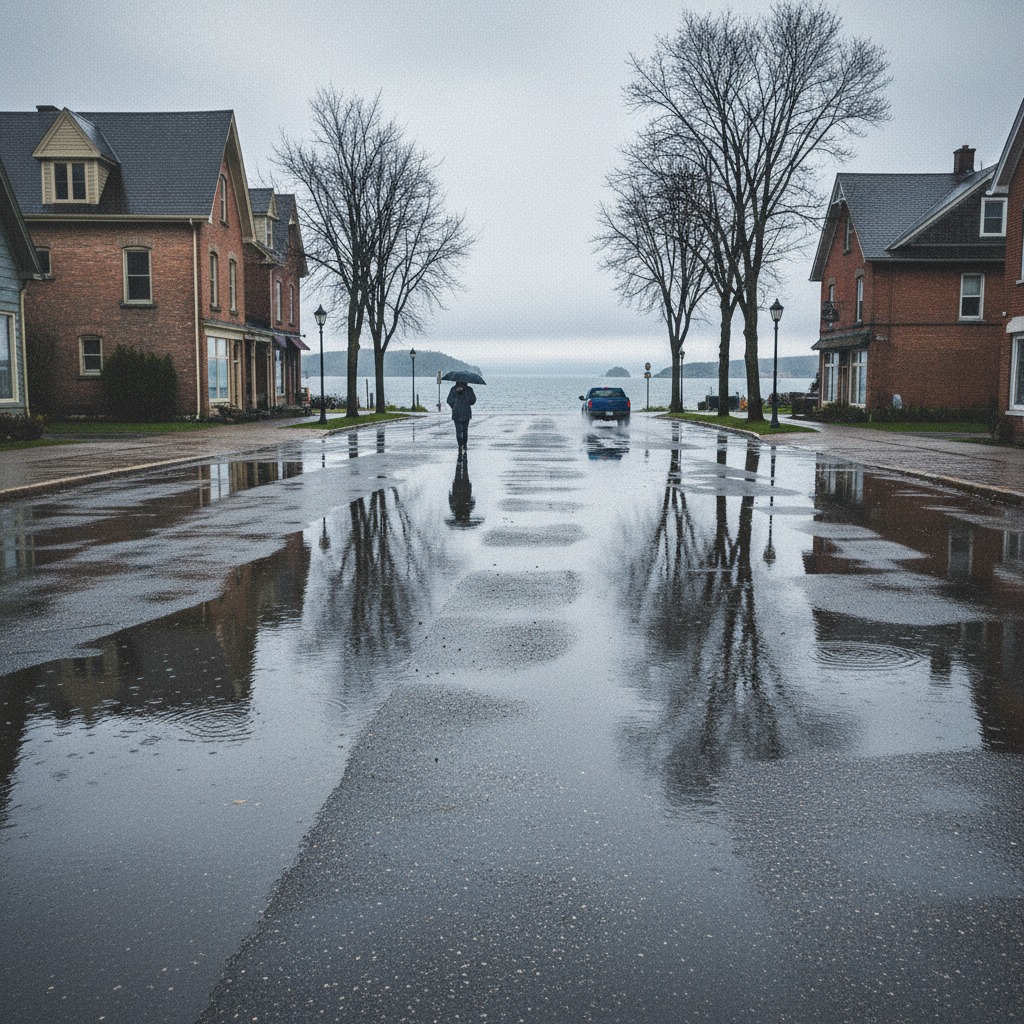
The volume matters, but so does the speed. Natural infiltration is a slow process that attenuates peak flows and spreads them out over hours or days. Stormwater runoff from hard surfaces arrives at the receiving water body in a concentrated pulse, often within minutes of the start of a storm. These pulses scour stream channels, erode banks, disturb spawning substrate, and flush sediment into lakes and wetlands where it smothers aquatic habitat.
The quality of that water is the other half of the problem. A comprehensive sampling program conducted by the Ontario Ministry of the Environment, Conservation and Parks found that urban stormwater routinely exceeds provincial water quality objectives for total suspended solids, total phosphorus, E. coli bacteria, heavy metals including zinc and copper, and chloride from road salt. In many watersheds, stormwater is now the single largest source of pollutant loading to the receiving water body.
What It Means for Waterfront Towns
For communities built along lakes and rivers, the consequences are direct and tangible. Beach closures are the most visible impact. When a heavy rainstorm washes E. coli and other pathogens into the nearshore zone, public health units post swimming advisories that can last for days. Towns like Wasaga Beach, Grand Bend, and Cobourg, whose summer economies depend on beach tourism, lose visitor days and revenue every time the water quality flags go up. Our article on water quality at small-town beaches across Ontario documents how widespread this problem has become.
Phosphorus loading from stormwater is a major contributor to algae growth in nearshore areas. Even on lakes that do not experience the massive blooms seen on Lake Erie, localized algae problems driven by urban runoff can affect water clarity, produce odour, and reduce the aesthetic appeal that drew people to the waterfront in the first place. The connection between nutrient loading and algae is examined in our report on algae blooms and the future of Lake Erie.

Erosion caused by concentrated stormwater discharge is degrading shoreline infrastructure in many communities. Where storm sewer outfalls empty onto unprotected banks, the high-velocity flow carves deep gullies that undermine roads, pathways, and retaining structures. Several municipalities along Lake Huron's southeastern shore have spent millions on outfall stabilization projects in the past decade, costs that ultimately land on local property tax bills.
Why the Problem Is Getting Worse
Two forces are amplifying stormwater impacts across Ontario. The first is continued development. Every new subdivision, commercial plaza, and road extension adds impervious surface area to the watershed. Even in communities with stormwater management plans, the cumulative effect of incremental development increases total runoff volume over time.
The second force is climate change. Ontario is experiencing more intense short-duration rainstorms than historical averages would predict. A storm that drops 40 millimetres in an hour generates far more runoff than one that drops the same amount over six hours, because the soil and drainage infrastructure cannot absorb or convey the water fast enough. Municipal stormwater systems that were designed based on historical rainfall data are increasingly overwhelmed by events that exceed their design capacity.
The combination is a recipe for escalating impacts. More pavement generating more runoff, hit by bigger storms, discharging into water bodies that are already stressed by nutrient loading and habitat loss.
What Towns Are Doing About It
The most forward-thinking municipalities in Ontario are moving beyond conventional stormwater management, which focused mainly on flood control, toward a more holistic approach called Low Impact Development, or LID. The premise of LID is simple: manage stormwater as close to where it falls as possible, using techniques that mimic natural infiltration and filtration.

Permeable pavement, which allows water to soak through the surface into a gravel reservoir below, is being installed in municipal parking lots and low-traffic roads in communities including Guelph, Brampton, and Collingwood. Bioretention cells, essentially engineered rain gardens with layered soil media, are being incorporated into new subdivisions and retrofitted into existing streetscapes. Green roofs on public buildings capture and evaporate rainfall before it reaches the storm sewer system.
At the property level, municipalities are encouraging homeowners to disconnect roof downspouts from the storm sewer, direct runoff onto permeable surfaces like lawns and gardens, and install rain barrels to capture roof runoff for later use. Some communities, notably the City of Kitchener, offer rebates for property owners who install rain gardens or other stormwater management features on their land.
Conservation authorities are also playing an increasingly active role. The Lake Simcoe Region Conservation Authority has been a leader in integrating stormwater management into its watershed planning and permitting processes, requiring LID measures in new development applications within the Lake Simcoe watershed. Similar approaches are being adopted by conservation authorities across southern Ontario, as detailed in our article on how conservation authorities regulate shoreline activity.
The Limits of Infrastructure
No amount of green infrastructure will eliminate stormwater impacts entirely. In established communities with dense development patterns, the opportunities for LID retrofits are limited by available space, soil conditions, and cost. In areas with high water tables or clay soils, infiltration-based techniques may not be practical. And even the best stormwater management cannot fully compensate for the ongoing addition of impervious surfaces across growing watersheds.
That is why many experts argue that the real solution is land use planning that limits impervious coverage in sensitive watersheds, particularly those draining to waterbodies that are already stressed. Setting meaningful impervious coverage limits, protecting natural drainage features like wetlands and stream buffers, and requiring developers to achieve pre-development runoff conditions are all policy tools that have proven effective in other jurisdictions.
For waterfront towns that depend on clean water for their identity and economy, managing stormwater is not just an engineering challenge. It is a question of whether the water that defines these communities will remain worth living beside. The restoration projects that have made a difference elsewhere in the province offer some encouraging models for what is possible when communities commit to doing the work.