
Shoreline Armouring: Protection or Problem?
Drive along almost any developed shoreline in Ontario and you will see the evidence: concrete seawalls, stacked limestone, gabion baskets filled with rock, steel sheet piling. These structures go by different names, but their purpose is the same. They are meant to stop the water from taking the land. In engineering terms, it is called shoreline armouring. In practice, it is a multi-million dollar gamble that does not always pay off.
Shoreline armouring has been the default response to erosion in Ontario for decades. Property owners watching their bluffs crumble or their beaches shrink understandably want a hard barrier between their land and the waves. But a growing body of evidence, and a growing number of failed structures, suggests that armouring often trades a short-term fix for long-term damage.
How Armouring Works
The most common forms of shoreline armouring in Ontario include seawalls (vertical structures made of concrete, steel, or wood), revetments (sloped surfaces covered with rock or armour stone), and breakwaters (offshore structures that reduce wave energy before it reaches the shore). Each has its place, and when properly designed and installed, each can provide effective protection for specific sites.

The trouble starts when armouring is applied in the wrong location, built to inadequate standards, or installed without understanding the broader coastal processes at work. A seawall that protects one property can redirect wave energy to the neighbouring shoreline, accelerating erosion next door. A revetment that is too steep or too smooth can prevent sediment from accumulating, starving downstream beaches of the sand they need to survive.
Coastal geomorphologists call this the "hardening paradox." The more you armour a shoreline, the more dependent you become on that armouring. Natural shorelines flex and adjust to changing water levels and wave patterns. Armoured shorelines cannot. When conditions exceed the design capacity of the structure, failure can be sudden and catastrophic.
The Cost of Getting It Wrong
Ontario's Great Lakes shorelines have no shortage of failed armouring projects. Along the Lake Erie bluffs near Port Stanley, homeowners who spent tens of thousands of dollars on rip-rap revetments in the early 2010s watched the structures break apart during the high water years of 2017 and 2019. The waves that overtopped the rock piles carried sediment away from behind the structures, creating voids that undermined foundations and accelerated the very erosion the armouring was meant to prevent.
On Lake Huron near Goderich, a stretch of municipal shoreline protected by a concrete seawall has experienced persistent scouring at the base of the wall. The wall itself is still standing, but the beach in front of it has eroded to bare bedrock. What was once a popular swimming area is now a wall facing open water, with no beach left to protect.
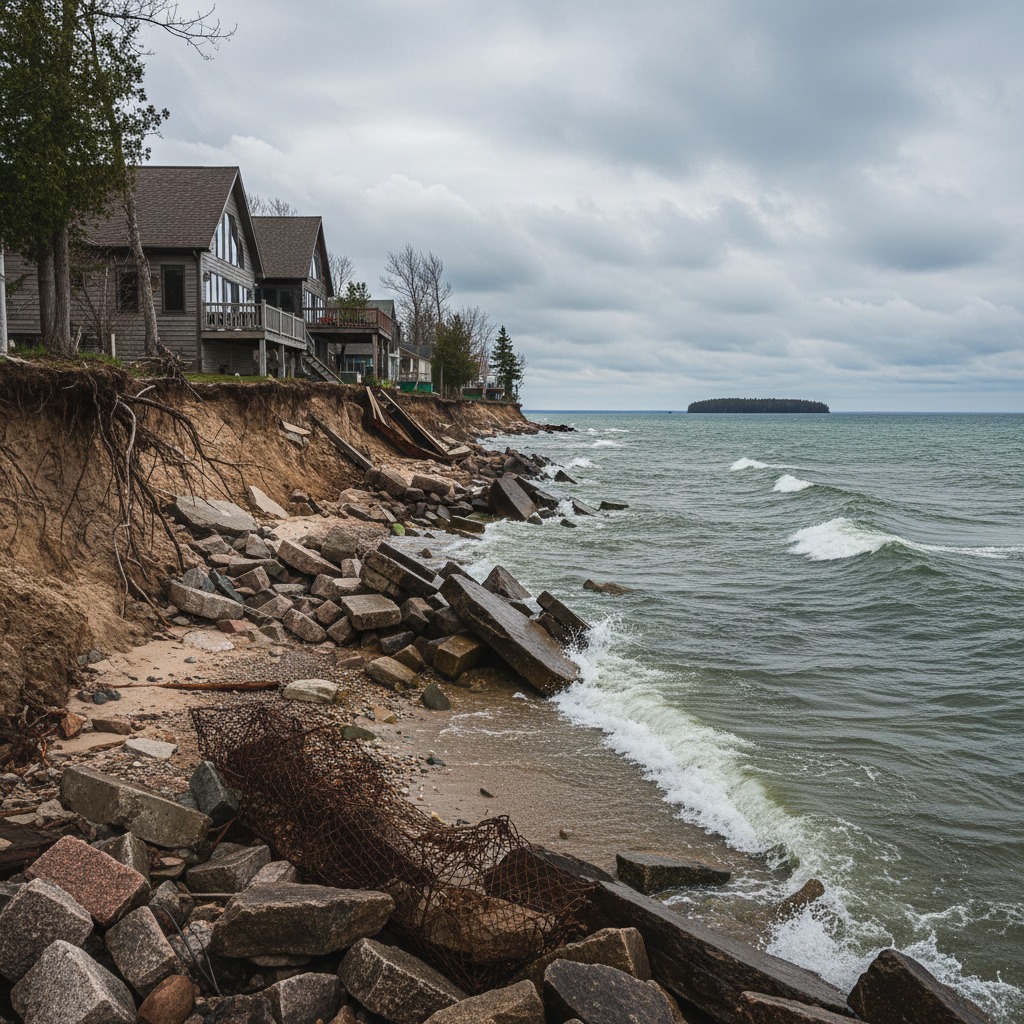
These outcomes are not unique to Ontario. Research from coastal engineering programs at universities across North America has documented similar patterns wherever hard structures are used to fight natural shoreline processes. The International Joint Commission, which oversees Great Lakes water management, has repeatedly cautioned against over-reliance on structural approaches to shoreline protection.
The Environmental Costs
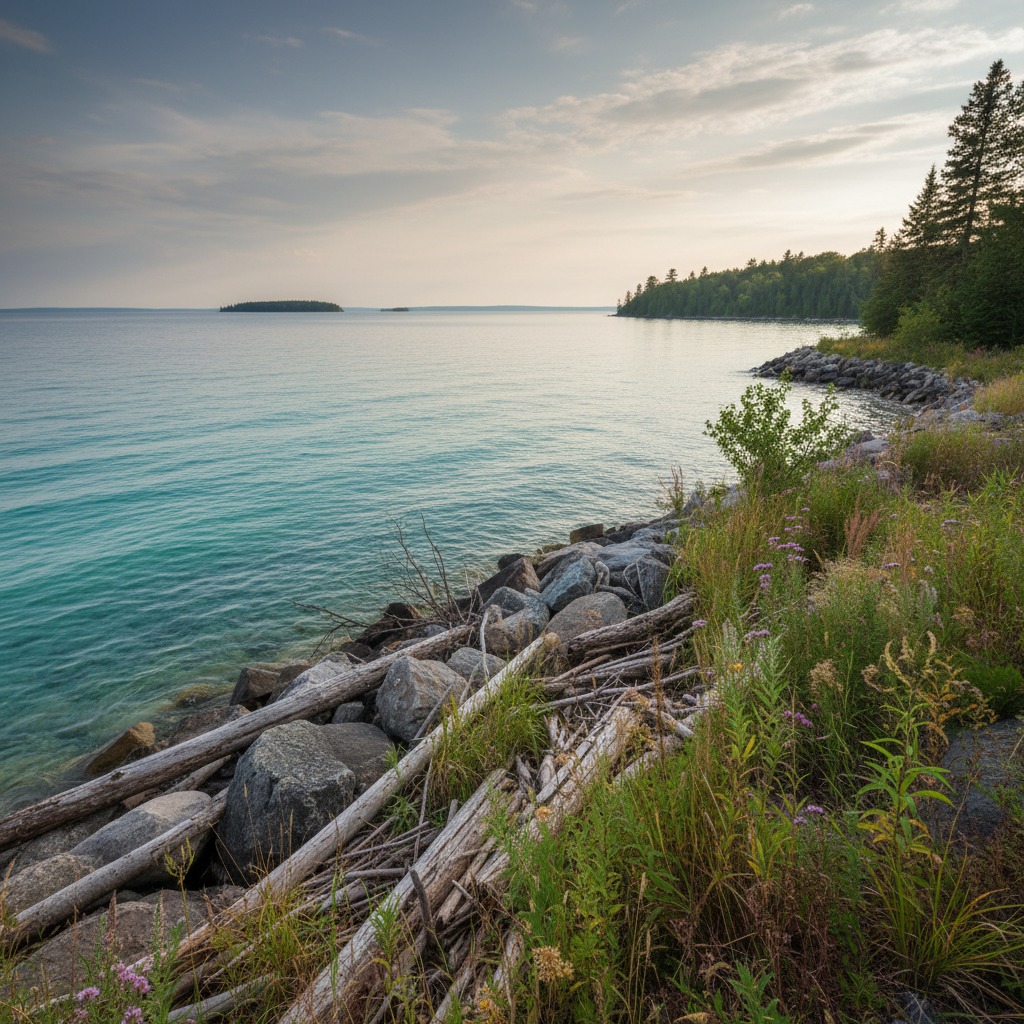
Beyond the structural risks, armouring carries significant environmental costs. Hardened shorelines eliminate the transition zone between land and water, a habitat type that supports a wide range of plant and animal species. Turtles that need sandy beaches for nesting, shorebirds that forage along natural shorelines, and fish that use shallow nearshore areas for spawning all lose habitat when a wall or rock pile replaces the natural shore.
The movement toward naturalized shorelines has gained traction in Ontario precisely because the ecological costs of armouring have become harder to ignore. Conservation authorities and environmental organizations now routinely advocate for "living shorelines" that use native vegetation, bioengineering techniques, and natural materials to stabilize banks while maintaining ecological function.
These approaches are not suitable everywhere. In areas of severe wave exposure or rapid bluff retreat, some form of structural protection may be the only realistic option. But even in those cases, hybrid designs that combine hard and soft elements tend to perform better over time than purely structural solutions.
Regulation and Oversight
In Ontario, shoreline armouring projects typically require permits from the local conservation authority and, if they affect fish habitat, authorization under the federal Fisheries Act. Municipal building permits may also be needed. In practice, however, enforcement varies widely. Some property owners install armouring without permits, either because they are unaware of the requirements or because they calculate that the risk of getting caught is low.
Conservation authorities have limited staff to monitor hundreds of kilometres of shoreline, and many prioritize review of new development proposals over enforcement of unauthorized works. The result is a patchwork of permitted and unpermitted structures along many Ontario shorelines, with no consistent standard for design, construction, or maintenance.
The conservation authority permitting process does require applicants to demonstrate that a proposed structure will not cause adverse impacts to neighbouring properties or the environment. But the quality of the technical assessments submitted varies enormously, and not all authorities have the in-house expertise to evaluate them thoroughly.
A Better Approach
The most effective shoreline protection strategies start not with engineering, but with understanding. Before any structure is designed, the coastal processes at work on a particular stretch of shoreline need to be assessed: wave climate, sediment transport patterns, water level fluctuations, and the geological characteristics of the bank or bluff material.
This kind of assessment costs money, and many property owners balk at spending thousands of dollars on studies before spending tens of thousands on construction. But the alternative, building a structure that fails within a decade or causes downstream damage, is far more expensive in the long run.
Municipalities and conservation authorities can help by making this information more accessible. Some, like the Lake Huron and Lake Erie conservation authorities, have developed shoreline management plans that provide site-specific guidance on appropriate protection approaches. These plans take years to develop but save property owners from making costly mistakes.
The bottom line is that shoreline armouring is neither inherently good nor inherently bad. It is a tool that works well when applied with knowledge and care, and causes harm when applied without either. Ontario's waterfronts would benefit from less reflexive wall-building and more thoughtful shoreline management, an approach that treats the coast as a dynamic system rather than a line to be held at all costs.